

Why Older Pools Shock Swimmers: Grounding and Bonding, Explained Plainly
Older South Florida pools can tingle before they shock. A Broward electrician explains pool grounding and bonding plainly, and the yearly inspection to book.
If you have ever climbed the ladder out of a pool and felt a faint tingle in the hand that gripped the metal rail, you already know the feeling this article is about. Most people brush it off. The water was cold, or a foot fell asleep, or it was just imagination. Sometimes it really is nothing. But a genuine tingle from a pool rail, a ladder, or a metal fitting is the pool trying to tell you something, and it is worth understanding what it is saying.
This is not a fear piece. Pools are wonderful, and a properly wired one is safe to enjoy every day of the year. But the electrical part of a pool is easy to take for granted, especially on older pools, so let us walk through how it actually works in plain language.
Grounding, in everyday terms
Think of the wires feeding your pool equipment as a loop. The hot wires carry current out to the pump and the heater, and the neutral wire carries it back. That is the working circuit, and current is supposed to stay inside it. There is one more wire, the ground, and its job is the opposite of the others. The ground is supposed to carry nothing at all, day after day, year after year. It is the spare path, sitting quietly, doing nothing.
The ground only comes to life when something has gone wrong. If a hot wire frays, or moisture gets where it should not, current can leak out of the loop where it belongs and try to find another way home. The ground is that way home. When the ground is suddenly carrying current, it is not failing. It is doing its one job, the exact job it has waited years to do, giving that stray current a safe path back to the panel so the breaker can notice and cut the power. Without that path, the stray current would simply sit on whatever metal it reached and wait for something, or someone, to complete the circuit for it. The ground exists so that the someone never has to be you.
Bonding, and why the metal is all tied together
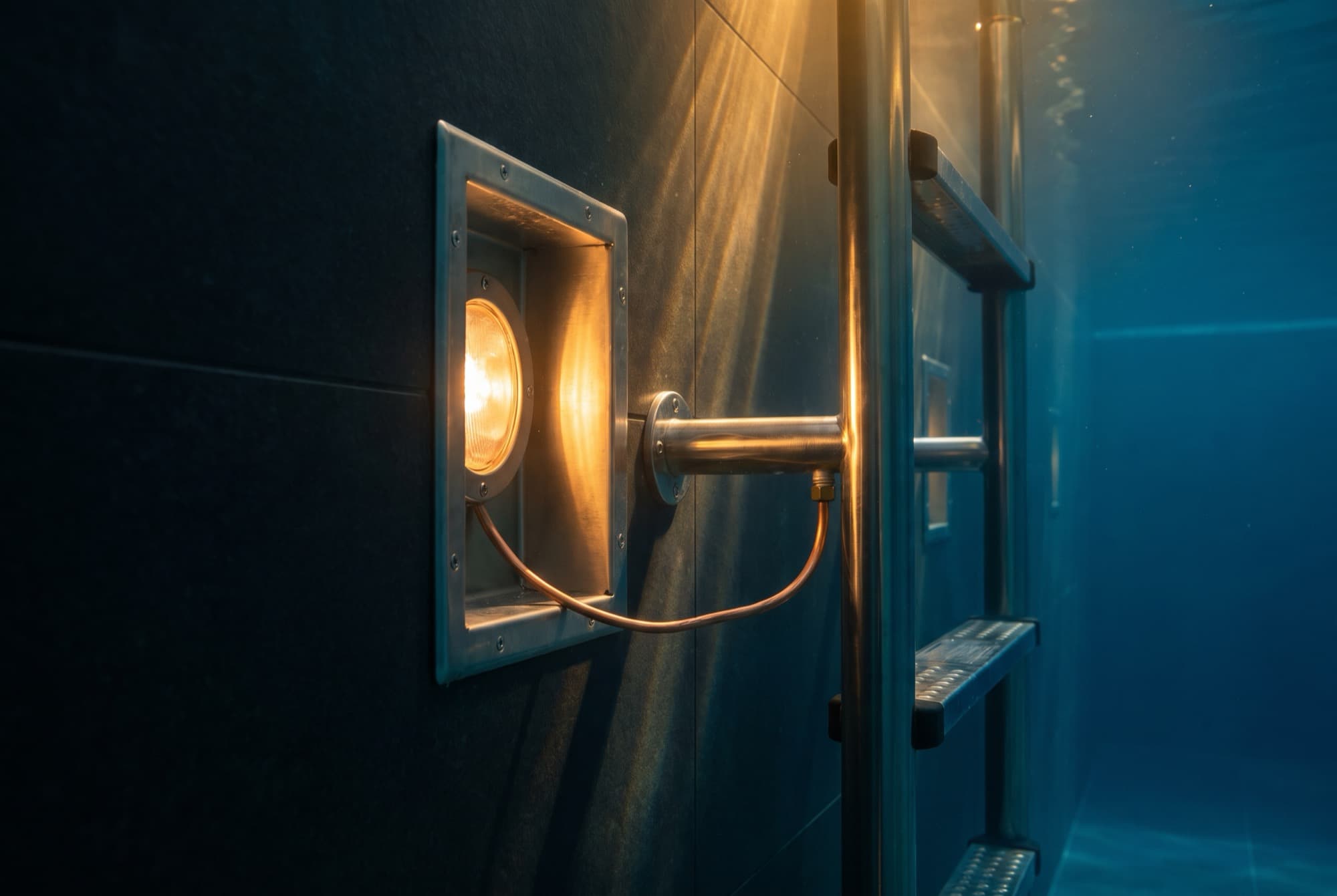
Around and inside a pool there is a lot of metal: the ladder, the handrails, the pump housing, the reinforcing steel in the shell, the light niche, sometimes the deck itself. Bonding is the practice of tying all of that metal together with a heavy copper conductor so that every piece sits at the same electrical level as every other piece.
Here is why that matters to a swimmer. Electricity only pushes current through you when there is a difference between two points you are touching, your hand on the rail and your body in the water, for example. When everything metal is bonded together properly, there is no difference for the current to push against. The rail, the water, and the ladder all sit at the same level, so nothing flows through the person in the middle. Bonding does not carry a fault away the way the ground does. It removes the difference that would drive current through you in the first place. Grounding gives a fault a path home. Bonding makes sure you are never the path.
What the tingle really is
Now the tingle makes sense. On an older pool, insulation breaks down, a fitting corrodes, a bit of moisture creeps into a connection, and a small amount of current leaks onto the metal. If the bonding has weakened or was never quite complete, the rails and fittings can end up at a slightly different level than the water. Reach out, complete the path with your own body, and you feel that faint buzz.
That tingle is the early warning. It is the system telling you a leak has started and the protections that should erase it are not fully doing their job. It rarely arrives all at once. It usually shows up small and gets mentioned as a nuisance long before it becomes anything more. That is exactly why it is worth taking seriously the first time, calmly, without panic. The risk, stated plainly and once: energized pool metal is genuinely dangerous, which is precisely why the layers of grounding and bonding exist, and why we check that they are intact.
Why roughly forty-year-old pools are the priority
Pools built around forty years ago are the ones we watch most closely, and it is not about age for its own sake. It is that the rules and the materials have improved a great deal since then, and four decades of South Florida sun, salt air, pool chemistry, and groundwater are hard on copper and steel. Bonding connections that were fine in the 1980s can corrode loose. Older equipment predates some of the protections we now consider standard. A pool from that era is not automatically unsafe, but it has earned a careful look at the parts you cannot see. Most of what protects a swimmer lives underground or inside the equipment, out of sight, which is exactly why a trained look matters more than a glance from the deck.
Two upgrades come up often on these older pools. The first is the breaker. Pool circuits should be protected by a water-rated, fast-trip breaker, the kind designed to sense a tiny imbalance and cut power in a fraction of a second, long before it becomes a problem for a person. If your pool equipment is still on an ordinary breaker, that is worth addressing. You can read more on the pool GFCI breaker replacement page.
The second is location. Code has moved the electrical panel that serves the pool out of the old pump enclosure and to a proper, accessible spot away from the wet equipment. On many older installations the panel is still tucked inside or right on top of the pump, which is exactly where you do not want it. Correcting that is part of a thorough pool electrical repair.
The honest cadence
People often ask how often any of this needs looking at, and the honest answer is once a year. A pool electrical inspection every year, ideally before heater season, is the right rhythm. Here that timing matters more than most places, because South Florida pools are heated and run right through the winter, so the season you most want everything working is the same season the equipment is under the most demand. Checking the bonding, the breaker, and the grounding before you fire up the heater is simply good timing. That is the whole cadence. Once a year, before heater season. We are not going to tell you to check it more often than it needs.
If any of this rang a bell, whether it was a real tingle or just the realization that your pool has been quietly working for decades without a look, the right next step is a proper pool grounding and bonding inspection. We come out, test what is actually happening at the rails and the equipment, and tell you plainly what we find.
When you are ready
There is no alarm to sound here and nothing to rush. If you felt a tingle, or you simply want the peace of mind of knowing an older pool is wired the way it should be, call us day or night or book your pool electrical inspection. We will explain what we find in plain language, and we will stay in our lane while we do it.
Services mentioned in this article
Pool & Spa Electrical
Water and electricity together demand special protection, and many older South Florida pools no longer have it.
View serviceSafety Inspections
If your carrier wants a 4-point inspection, or something just feels off, an inspection is the honest answer.
View servicePanel Upgrades
A failing panel shows it: breakers that trip repeatedly, a burning smell, scorch marks, or lights that dim when the AC starts.
View service