Why Your Insurance Company Cares About Your Electrical Panel
Florida insurers are dropping homes with Zinsco and Federal Pacific panels. A licensed Broward electrician explains the four-point rule and what to do next.
If you own or manage a home in South Florida, you may have opened a letter from your insurance carrier lately that asked, in so many words, about the gray metal box on the side of your house. For most people that letter is the first time they have ever given their electrical panel a second thought. It has sat there quietly for thirty or forty years and never once asked for attention. So why is it suddenly the thing standing between you and a renewed policy?
The honest answer is that two panel brands, Zinsco and Federal Pacific, carry a known history, and the companies that insure your home have been paying attention to it for years. This is not a scare campaign and it is not about selling you anything you do not need. It is about understanding what the panel does, why these two brands worry the people who calculate risk for a living, and what an honest replacement looks like so you can tell a fair bid from a bad one.
What a panel is supposed to do
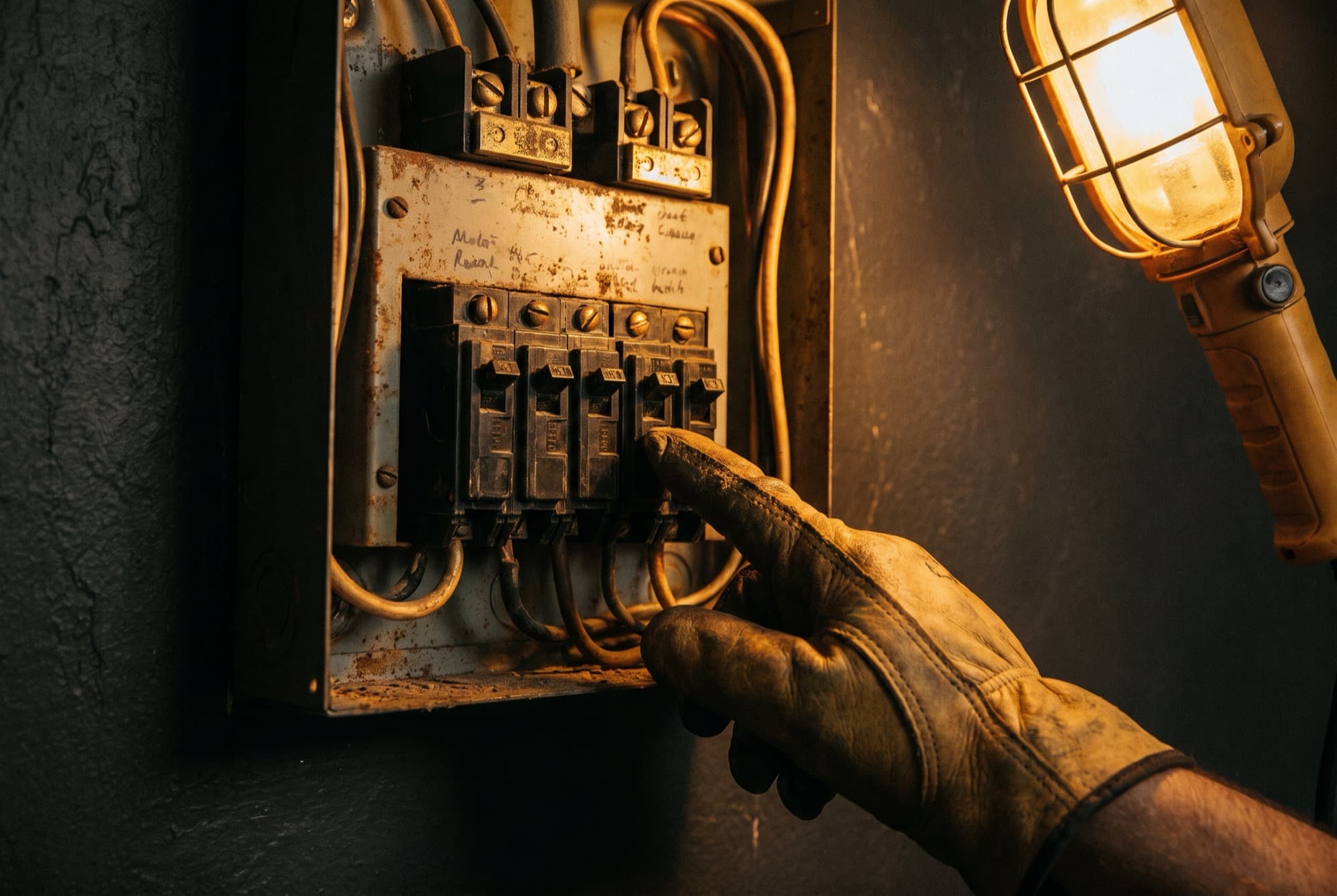
Your electrical panel is the heart of the whole system. Power comes in from the utility, passes through the meter, and lands in the panel, where it is split into the circuits that feed your lights, your air handler, your kitchen, and every outlet in the house. Inside the panel, each circuit runs through a breaker. A breaker is a small safety switch with one job: when a circuit pulls more current than it is rated to carry, the breaker is supposed to trip and cut the power before the wire behind your wall has a chance to overheat.
That is the entire point of the device. Electricity is something we do not see, we only feel the effect, so we rely on the breaker to watch the circuit for us and act the instant something goes wrong.
Where Zinsco and Federal Pacific come in
Zinsco and Federal Pacific Electric, often shortened to FPE, were two of the most common panel brands installed in American homes built roughly from the 1950s into the early 1980s. FPE panels usually carry Stab-Lok breakers. Zinsco panels sometimes wear a Sylvania or GTE-Sylvania label. Millions of them went into houses across the country, and a great many of those houses are right here in Broward and the rest of South Florida, where a large share of the housing stock dates to exactly that era.
Here is the plain version of the problem, stated once. Over the years, independent testing and decades of field experience have shown that some breakers in these two brands can fail to trip when they should. A breaker that does not trip lets an overloaded circuit keep drawing current, and a wire that keeps heating with nowhere to shed that heat is how an electrical fire starts. That is the risk. It is real, it is documented, and it is the reason we are having this conversation. I am going to say it that once and then move on, because fear is not the point. Understanding is.
Why South Florida carriers care now
Insurance companies are in the business of pricing risk. When a specific component has a documented history of not doing its safety job, carriers respond the way you would expect: they ask for it to be removed, or they decline to write or renew the policy on a home that still has one. Over the last several years this has tightened considerably across Florida, partly because so much of our housing stock is the right age to still have these panels, and partly because the state insurance market as a whole has grown far less forgiving of anything that raises the odds of a claim.
For older homes, carriers commonly require a four-point inspection before they will write coverage. The four points are the roof, the heating and cooling, the plumbing, and the electrical. Your panel is the electrical point. If the inspector writes down Zinsco or Federal Pacific, that single line can hold up your entire policy.
What a four-point failure actually means for you
If a four-point inspection flags your panel, the carrier will usually give you a window to replace it as a condition of coverage. For a homeowner, that means a deadline and a decision. For a property manager, it can mean the same deadline repeated across several units, with tenants who still need the lights and the air conditioning to work the entire time the paperwork is being sorted out. None of this is an emergency in the fire sense, but it is a real clock, and it helps to start early rather than the week before a renewal date.
The good news is that this is routine work for a licensed shop. Replacing one of these panels is one of the most common jobs we do, and once it is done correctly and inspected, that line item on your insurance file is closed for good.
What an honest replacement involves
A proper panel replacement is not a mystery. Here is how it goes when it is done right.
It starts with a phone call. I take the call myself, ask what your letter says, ask what brand and what condition the panel is in, and get a first read on the situation. From there we set a site visit, because no honest price can be quoted over the phone for work like this. On site we look at the panel, the meter, the service coming in, and the overall condition of the system, so nothing surprises anybody later.
Then you get one price, built from a real forecast of the actual work. Price it once, price it right. That number does not move in the middle of the job. If something genuinely hidden turns up once a wall or a cover is opened, you hear about it before another minute of work happens, and you decide. The work itself is done by our own in-house crew, not a rotating cast of subcontractors. We pull the permit, and when the inspection is scheduled, I meet the inspector personally. That is not a detail we delegate.
If your flagged panel is a Zinsco, the fix lives here: Zinsco panel replacement. If it is a Federal Pacific, start here: Federal Pacific panel replacement. If the panel simply needs to grow with the house, that is a panel upgrade.
How to read a replacement bid
Since you will likely gather more than one bid, here is how to read them like someone who knows what matters.
First, licensing. Ask for it directly. The contractor should be a Florida Certified Electrical Contractor with statewide authority and, here in our county, a Broward County Master Electrician. A license is not paperwork for its own sake. It is your proof that the person touching the heart of your electrical system has been tested and held accountable.
Second, permits. A real panel replacement is permitted and inspected, full stop. If a bid is cheaper because it quietly skips the permit, that is not a bargain, it is a liability. Unpermitted electrical work can be rejected by your own insurance carrier, which defeats the entire reason you are doing this.
Third, a price that holds. A trustworthy bid is quoted once from an honest assessment and does not drift upward once the crew is committed and your power is already off. You are paying for the experience of someone who can look at the job and forecast it accurately the first time.
When you are ready
If you have a letter in hand, or you looked at your panel and saw one of those two names, there is no need to panic and no need to wait until the deadline is breathing down your neck. Call us, day or night, and we will walk you through exactly what your situation needs and what it will take to close it out. We show up when we say we will, and we stay in our lane so the work is done once and done right.
Services mentioned in this article
Panel Upgrades
A failing panel shows it: breakers that trip repeatedly, a burning smell, scorch marks, or lights that dim when the AC starts.
View serviceSafety Inspections
If your carrier wants a 4-point inspection, or something just feels off, an inspection is the honest answer.
View serviceService & Meter Upgrades
Sometimes it is not one panel or one breaker, it is the whole service showing its age, and patching one piece just moves the trouble along.
View service